
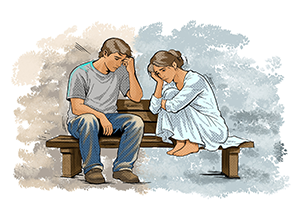
1.1 Do women and men experience schizophrenia differently?
“What may look like indifference, irritability, or emotional
instability is often part of how the illness is expressed, not
a reflection of love, character, or commitment.”

1.1 Do women and men experience schizophrenia differently?
“What may look like indifference, irritability, or emotional
instability is often part of how the illness is expressed, not
a reflection of love, character, or commitment.”
Elena:
Let’s start with a question many caregivers ask, sometimes quite directly:
Is schizophrenia different in women and men?
Dr. Stein:
That’s a very fair question. And the short answer is yes, we do see some consistent differences.
At the same time, it’s important to approach this carefully.
These are not strict rules or stereotypes, but patterns we
observe in both research and everyday clinical practice.
Elena:
When we talk about differences, we’re not labeling people, but trying to understand better what families experience.
Dr. Stein:
Exactly. Over time, clinicians notice certain tendencies, how symptoms develop, how emotions are expressed, and how relationships are affected. These patterns don’t define any one person, but they can help make sense of experiences many patients and partners describe.
Some families put it very simply:
These are not strict rules or stereotypes, but patterns we
observe in both research and everyday clinical practice.
Elena:
That’s something many people recognize, the feeling that the person is still there, but harder to reach.
Dr. Stein:
Yes, and these changes can show up in everyday life in different ways.
For example, men often develop symptoms a little earlier, usually in their late teens or early twenties. Because this happens during an important period of education and social development, it can interrupt friendships, studies, or early career plans.
Elena:
And for women, the timing is often different?
Dr. Stein:
That’s right. Women tend to experience their first symptoms slightly later. In some cases, there may also be a second period of vulnerability later in adulthood, often during phases of hormonal transition, when changes in hormone levels can influence emotional and cognitive stability.
Elena:
So biology may play a role not only at the beginning, but also later on.
Dr. Stein:
Yes, it can. And we also see differences in how symptoms are expressed. Negative symptoms, such as reduced motivation, less facial expression, or social withdrawal, are often more noticeable in men. Families may experience this as emotional distance or feel that something in the connection has changed.
Elena:
That’s often interpreted as “he doesn’t care anymore,” even when that’s not the case.
Dr. Stein:
And in women, we often see something different. Emotional symptoms such as anxiety, sadness, or mood changes may be more prominent. They may remain expressive, but at times feel more easily overwhelmed.
Elena:
So the expressions are different, but the emotional experience is still there.
Dr. Stein:
Very much so. And that’s why understanding these patterns is so important.
They are not predictions, and they are never absolute. Every person is unique. But recognizing them can help prevent misunderstandings.
What may look like indifference, irritability, or emotional instability is often part of how the illness is expressed, not a reflection of love, character, or commitment.


 Optimized by Seraphinite Accelerator