Clinical Story
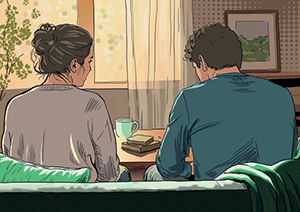
“I didn’t know if this was something I was allowed to talk about…”
Clinical Story
“I didn’t know if this was something I was allowed to talk about…”
Elena:
Before we close, Dr. Stein, could you share an example that brings all of this together?
Dr. Stein:
Of course.
I remember a man in his early thirties. His symptoms had improved significantly, and from a clinical perspective, everything seemed stable.
But during a follow-up visit, his partner mentioned that something had changed. He had become distant. Less affectionate. Less engaged.
At first, they both thought this was part of the illness. But when we gently explored the topic, he admitted something he hadn’t said before:
“I don’t feel like myself anymore… not in that part of my life.” He paused and then added quietly, “I didn’t know if this was something I was allowed to talk about.”
He had been experiencing changes in sexual functioning, but felt too uncomfortable to bring it up.
Elena:
The issue wasn’t the relationship itself.
Dr. Stein:
It was a treatment-related effect that had never been discussed.
Once the conversation was opened, we reviewed options together. Adjustments were made carefully, and over time, both his confidence and the relationship improved.
Elena:
So the turning point was simply talking about it.
Dr. Stein:
Yes. Not a dramatic intervention. Just a safe conversation.
Sometimes, what appears to be emotional distance is actually an unspoken, manageable issue.
When patients, partners, and clinicians speak openly:
• trust improves
• adherence strengthens
• relationships recover.
Final reflection
Elena:
What I take from today is that treatment does more than reduce symptoms; it can also influence how people experience themselves, their relationships, and intimacy.
Dr. Stein:
Treatment is part of everyday life, not separate from it. When it fits well, it supports not only stability but also confidence, connection, and the ability to be present in relationships.
And when something doesn’t feel right, especially in such a personal area as intimacy, it’s important to know that this can be discussed, understood, and often adjusted.
Elena:
The goal is not to avoid treatment, but to stay engaged with it, and to talk openly about how it affects real life.
Dr. Stein:
When people feel heard, and when their personal experiences are part of the conversation, treatment becomes something they can live with, not something they have to endure. And often, it’s these conversations, simple, honest, and sometimes difficult, that protect both relationships and recovery over time. Not always comfortable, but often necessary.
Elena:
And in many ways, this brings us to another important question that naturally follows.
If treatment, physical health, and intimacy are all connected, what happens when people begin to think about having children?
Dr. Stein:
That’s a very important step.
Questions about fertility, reproductive health, and family planning often come at a time when people are beginning to feel more stable and are thinking about their future more seriously.
These decisions are deeply personal, but they are also closely connected to everything we’ve discussed: treatment, physical health, relationships, and confidence.
Elena:
Family planning is therefore not a separate topic, but a continuation of the same conversation.
Dr. Stein:
With the right information, planning, and support, these conversations can become not a source of uncertainty, but a way to build a future that feels both safe and meaningful.
Elena:
In our next chapter, we’ll explore how fertility, reproductive health, and family planning can be approached in a thoughtful and informed way.
Until then, take care, and we look forward to continuing this conversation with you.